
Drive Medical Rollator Walker with Seat
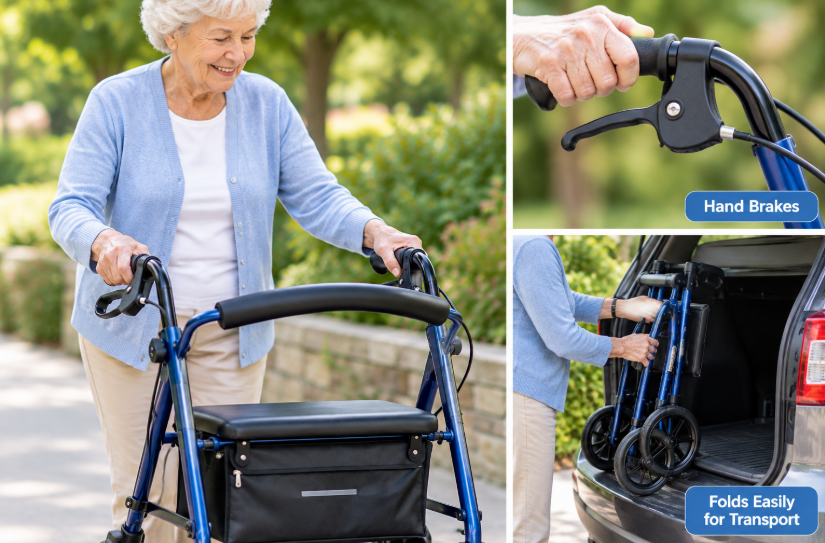
A classic, well-reviewed rollator from one of the best-known mobility brands, with a padded seat for resting, loop hand brakes and 7.5-inch wheels for smooth rolling indoors and out.
Check Price on Amazon →Choosing the best walker or rollator for seniors is one of those decisions that looks simple until you’re standing in front of a dozen nearly identical options. Watching a parent or loved one shuffle cautiously or reach for walls for support is unsettling — but the right walking aid can genuinely restore confidence and extend independent living by years. The most common mistake families make is assuming a rollator is simply a “better” walker than a standard frame. They serve different needs, and choosing the wrong type can actually make mobility worse, not better.

Walker vs. Rollator: The Decision Most People Get Wrong
Standard (pickup) walkers are four-legged frames the user lifts and places forward with each step. They provide the most stability of any walking aid, but require enough upper body strength to lift the frame repeatedly — making them best suited for users recovering from surgery or with significant balance impairment who need maximum support over shorter distances.
Rollators are wheeled walkers with hand brakes, typically a padded seat, and storage — the user pushes rather than lifts, requiring less upper body strength and allowing a more natural walking gait. They’re generally better suited to users with balance concerns or fatigue who can still walk independently but need support and rest breaks along the way.
The general rule: if the primary need is maximum stability for someone who can’t safely bear weight without a rigid frame, a standard walker is usually right. If the person can walk but tires easily or needs balance support rather than full weight-bearing assistance, a rollator is almost always the better choice.
What Actually Matters When Choosing
1. Three wheels vs. four wheels (for rollators). Four-wheel rollators include a built-in seat, more storage, and better stability — the right choice for most seniors. Three-wheel rollators are lighter and more maneuverable in tight spaces, but lack a seat, a meaningful tradeoff for anyone who tires on longer walks.
2. Wheel size. Larger wheels (7.5-10 inches) handle outdoor terrain — sidewalk cracks, curbs, uneven ground — far better than smaller wheels, which are fine for smooth indoor use but can catch or stall outdoors.
3. Weight capacity with real margin. Standard rollators typically support 300-350 lbs, with bariatric-rated models reaching 380-400+ lbs. As elsewhere on this site, match capacity comfortably above the user’s actual weight.
4. Handle height adjustability. Confirm the height range covers the actual user — most rollators adjust to fit users roughly 5’0″ to 6’2″, but always check the specific model, especially for users at either end of that range.
5. Brake quality for arthritic hands. Hand brakes vary significantly in how much grip strength they require — this matters enormously for users with arthritis, and is often only clear from real user reviews rather than spec sheets.
6. Weight of the walker itself. A lighter frame (13-20 lbs) is easier to lift into a car trunk or maneuver up a step, but often trades off some stability or durability compared to heavier steel frames (20-25+ lbs).
Comparison at a Glance
| Model | Type | Wheels | Weight Capacity | Weight | Approx. Price | Best For |
|---|---|---|---|---|---|---|
| Drive Medical Rollator Walker with Seat | Rollator | 4-wheel | 300 lbs | ~17 lbs | ~$70–$110 | Most proven all-around choice, huge review base |
| Medline Steel Rollator | Rollator | 4-wheel, 7.5" wheels | 350 lbs | Standard steel frame | ~$55–$70 | Best budget option with solid core features |
| VOCIC Z11 | Rollator | 4-wheel | 380 lbs | Reinforced steel frame | Under $60 | Highest weight capacity in this lineup, durability-tested |
| Vive Folding Walker | Standard walker | 2-wheel (front) | Standard | ~7 lbs | Budget–mid | Lightweight indoor use, tight spaces, portability |
Prices fluctuate by retailer — always verify current pricing before publishing or purchasing.
The Four Options, In Detail
Drive Medical Rollator Walker with Seat — Best Overall (Check price on Amazon →)
With tens of thousands of reviews and a 4.6-star average, this is the most extensively proven rollator on the market. It adjusts to fit users from 5’0″ to 6’2″, with a 12×14-inch padded seat and a 300 lb weight capacity that comfortably covers most users. It’s a dependable, no-surprises choice for daily use both indoors and on typical outdoor sidewalks.
Best for: families wanting one reliable, well-tested rollator without needing to compare niche features.
Drive Medical Rollator with Seat — Best Budget Option
A classic, budget-friendly rollator with the core features that matter: a padded seat for resting, loop hand brakes, and 7.5-inch wheels that handle both indoor floors and outdoor sidewalks. Check the weight capacity and seat height on the listing to match the user.
Best for: budget-conscious families who still want solid stability and outdoor capability.
VOCIC Z21 Rollator — Best for Higher Weight Capacity (Check price on Amazon →)
With a 380 lb weight capacity — the highest in this comparison — and a reinforced steel frame tested through 200,000 high-impact cycles during development, this is built for durability and higher support needs without stepping up to a specialized bariatric-only rollator.
Best for: users needing more weight capacity than standard rollators provide, without paying bariatric-specific pricing.
Medline Heavy-Duty Folding Walker — Best for Higher Weight Capacity
A sturdy folding walker with 5-inch front wheels and a 500 lb weight capacity (per the listing), a good fit for larger users or anyone who needs maximum stability. It’s built for smooth indoor rolling rather than outdoor terrain, and doesn’t include a seat or storage.
Best for: users who primarily need indoor balance support and prioritize easy folding and portability over outdoor capability or extra features.
A Note on Proper Fit
Handle height should allow the user’s elbows to bend at roughly a 15-degree angle when standing upright with hands on the grips — too low forces a stoop, too high doesn’t provide proper support. If possible, have the user try the actual walker or rollator in person, or measure carefully against the manufacturer’s height chart before ordering, since correct fit affects both safety and comfort more than any other single factor.
As with every recommendation on this site, products are evaluated for genuine stability, durability, and real-world usability — not just review counts or price alone. This page contains affiliate links. As an Amazon Associate (website0079-20), I earn from qualifying purchases.
Frequently Asked Questions
Does Medicare cover walkers and rollators?
Yes — Medicare Part B covers walkers (including rollators) as durable medical equipment when prescribed by a doctor and purchased from a Medicare-approved supplier. Coverage typically includes 80% of the approved amount after your Part B deductible. The walker must be medically necessary and appropriate for your condition.
How do I adjust a rollator to the correct height?
Stand upright with your arms hanging naturally at your sides. The handles should align with your wrist creases — allowing a slight bend in the elbows (roughly 15 degrees) when gripping. Handles set too low cause stooping; too high creates shoulder strain and reduces the stability benefit. Most rollators adjust in 1-inch increments.
What is the weight limit on a standard rollator?
Most standard rollators are rated to 300–350 lbs. Bariatric rollators typically reach 450–500 lbs and are wider with a reinforced frame. Always match capacity comfortably above the user’s actual weight — operating near the rated limit stresses the frame and wheels over time.
Walker vs. rollator — which is safer for someone who has had a fall?
A standard pickup walker generally provides more stability than a rollator for someone immediately post-fall or recovering from surgery, because it requires lifting and placing rather than rolling — which forces a deliberate, slower pace. Once stability has returned and the person is walking more freely, a rollator is often more comfortable for everyday use. Discuss with a physiotherapist if you’re unsure which is appropriate after a specific incident.
This page contains affiliate links. As an Amazon Associate (website0079-20), I earn from qualifying purchases.
See our Affiliate Disclosure for details.